
By Stefanie Breiteneder, co-chief in the Health Center for the Deaf in The Institute for Neurology of Senses and Language of Konventhospital Barmherzige Brueder Linz and member from PUENTE Project
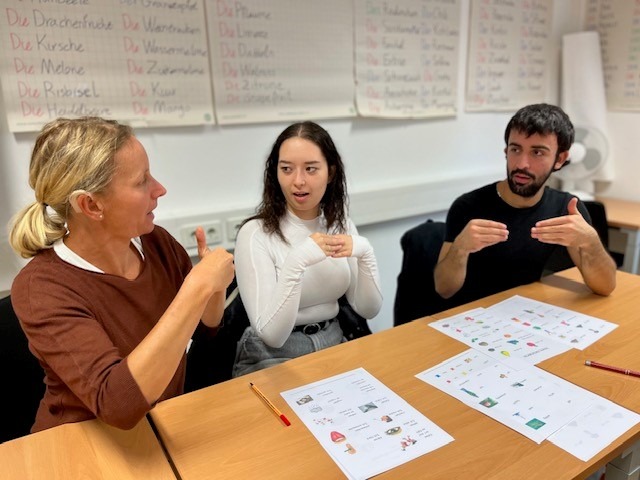
“People with hearing impairments are primarily affected by communication barriers. In their new home, hearing-impaired displaced persons must learn not just one, but two new languages: Austrian Sign Language and written German. Trainers therefore play an essential role in language integration, as well as in addressing communication barriers and teaching how to overcome these, e.g., how to book an interpreter,” explains Stefanie Breiteneder from Barmherzige Brüder Konventhospital Linz underlining the difficulties refugees with disabilities face in being included in everyday social life.
Stefanie have been working for more than 15 years as a social worker and is part of the Institute for Neurology of Senses and Language, part of the Konventhospital Barmherzige Brüder Linz. This institution was founded in 1993 as a specialist outpatient clinic for deaf people and today has more than 350 professionals. Through the Health Center for the Deaf, it provides barrier-free and holistic healthcare, as well as social and educational services, always placing the individual at the center. Its mission is to support people facing communication barriers—such as Ukrainian deaf refugees—in developing their potential and achieving full inclusion in society.
She highlights that when it comes to people with disabilities—especially those not immediately visible—they are too often overlooked in society, even within state refugee care systems. “For us as professionals in this field, constant efforts of raising awareness and education are needed to highlight the specific needs. For example, the use of essential aids such as sign language interpreters, the use of relay interpreters or visual fire alarms to ensure the safety of people with disabilities. In Article 11 of the UN Convention on the Rights of Persons with Disabilities, Austria has committed itself to taking all necessary measures to ensure the protection and safety of people with disabilities in humanitarian crises and we must constantly remind on that.”
This aligns with the European Economic and Social Committee (EESC), which emphasized in a dedicated conference the particular vulnerability of refugees and migrants with disabilities, recalling the duty to fully implement Article 11 of the UNCRPD to ensure their protection and safety in crisis situations. UNHCR’s Regional Protection Analysis also confirms this vulnerability, showing that 22% of Ukrainian refugee households include at least one person with specific needs, such as disability or chronic illness, which significantly increases their risks in accessing housing, healthcare and education
Lessons for Europe: inclusion benefits all
From Stefanie’s perspective, inclusive education is not about designing for one group, but about benefiting every person:
“Inclusion means it is for everyone. The methods are not designed for a specific group of people, but help all learners. Audio files can also help sighted people learn the correct pronunciation, and so can visual material support the learning process of different learners. PUENTE Project therefore shows how inclusive education and diversity create a larger repertoire of methods that benefit all learners and therefore also the community.”
This vision resonates with both research and practice.The EESC has stressed that integrating refugees with disabilities requires a comprehensive rights-based approach—covering healthcare, housing and education—while ensuring strong cooperation between institutions and civil society and strengthening the capacity of local authorities. Our PUENTE Project study found that lack of information and psychological support remain key barriers for Ukrainian refugees in Europe. Similarly, UNHCR reports that 87% of Ukrainian refugees identify at least one urgent unmet need, including education, healthcare, and access to clear information.
Adapting non-formal education to diverse needs
Stefanie underlines that inclusion requires constant adaptation: “PUENTE strives for inclusion and must therefore take various forms of disability into account. Methods must be adapted to different needs; for example, there must be easy-to-read documents, and videos must be provided with audio descriptions for visually impaired refugees or subtitles for deaf people.”
This is consistent with UNHCR data, which shows that 12% of refugee households report having at least one person with a disability. These households face greater challenges accessing healthcare—39% report difficulties compared to 23% of other households—and have significantly lower employment rates (21% compared to 34%). Such evidence reinforces why projects like PUENTE Project need to embed accessibility in every layer of their methodology.
PUENTE Project: accessibility in practice
Accessibility is not abstract; it requires practical tools. As Stefanie explains:
“In order to integrate accessibility into the project, a module was dedicated to inclusive educational practices. This module provides concrete examples of methods that are adapted to different types of disabilities. Here, for example, picture cards and audio files are discussed.”
The emphasis on accessible learning materials also responds to our results: lack of accessible information remains one of the key barriers to integration for refugees. Following UNHCR findings, many, particularly older persons and people with disabilities, struggle with digital tools.
As Stefanie reminds us, inclusive education is not just a right: it is a collective benefit. When inclusion is fully integrated, it enriches learning for everyone and strengthens the resilience of communities across Europe.
Leave a Reply