

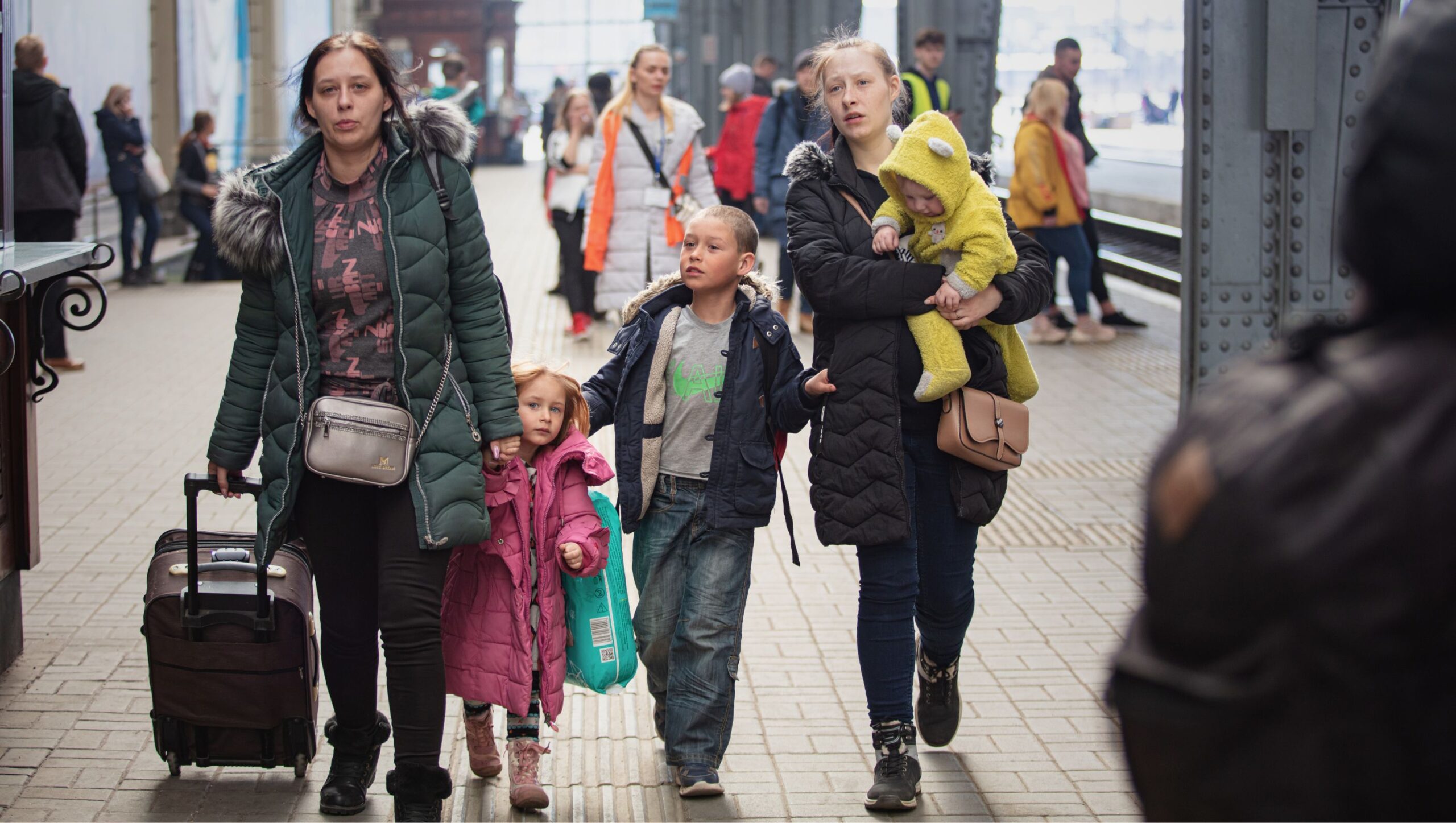
By the end of 2023, 19.5 million people were forcibly displaced in Europe, of which 13 million were refugees. And the trend shows no sign of slowing. In 2024, the total number of people under the protection or assistance of the UNHCR rose to 129.9 million worldwide, in a global scenario marked by protracted conflicts, climate crises and rising social tensions. Europe accounts for a significant share of this reality, with millions of people requiring international assistance, according to the EU Civil Protection and Humanitarian Aid.
Ukrainians as a paradigmatic case
Since the Russian invasion in 2022, more than 4.3 million Ukrainians have been granted temporary protection in the European Union. This status provides residence, access to employment and basic services, but reports underline that merely granting legal protection does not eliminate the informational, social or emotional barriers that prevent full integration.
In its recent report, PUENTE Project reveals concrete data from its research with Ukrainian refugees in Europe. Among its findings: a significant share of respondents identify lack of clear information (e.g. about rights, procedures, resources) and the absence of continuous psychological support as two of the most critical barriers to inclusion. This aligns with their testimonies that, despite legal access to services, many feel lost in navigating institutional systems or unsupported in coping with stress, trauma, or uncertainty. (see the PUENTE report: “Ukrainian refugees in Europe highlight lack of information and psychological support as key barriers for their inclusion”)
The UNHCR Operational Data Portal on the Ukraine situation also flags shortcomings: insufficient mental health coverage, delays in support services, and language barriers to accessing medical and psychosocial care.
Across Europe, the picture is similar. In Spain, over 236,000 people have received temporary protection, but only around 28,000 have secured stable jobs, mostly in low-skilled sectors. Portugal has made progress through lifelong learning initiatives, though stable housing remains a challenge. Austria has prioritized language and employment programs, yet highly educated women and young people face barriers to validating their qualifications. Italy combines vocational training with cultural initiatives, but long-term employment remains elusive. Belgium’s bilingual system complicates already complex inclusion programs. And in Poland—the main host country, with over 1.5 million Ukrainians—the focus on humanitarian aid now faces the challenge of transforming into sustainable integration.
These examples show that forced displacement is not episodic but structural, underscoring the urgent need for sustainable, transnational inclusion strategies.
Critical barriers to inclusion
The EUAA Asylum Report 2024 confirms that despite legal progress, serious obstacles remain in accessing housing, social benefits, and employment. Even where legal frameworks allow refugees to work, factors such as lack of recognition of qualifications, language barriers, and complex bureaucracy slow down real integration. Refugees often encounter opaque processes, limited orientation, and poor communication, which undermine autonomy.
Mental health: an invisible fragility
The World Health Organization warns that refugee populations show significantly higher rates of depression, anxiety, and post-traumatic stress disorder (PTSD). A systematic review places depression prevalence among refugees and asylum seekers at 30–40%. The EUAA mental health report adds that 1 in 11 people who have lived in conflict zones may develop moderate to severe mental disorders in the following years.
Additional barriers worsen the problem: cultural stigma, lack of awareness of available services, shortages of trained interpreters or culturally competent professionals, and interruptions in treatment, as highlighted by BioMed Central and ScienceDirect. More recent studies, such as Kiely et al., 2025, confirm persistently high levels of stress, anxiety, and depression among refugees and asylum seekers in Europe.
The message is clear: mental health cannot remain secondary—it must be a central pillar of inclusion strategies.
PUENTE Project: building bridges through non-formal education
Against this backdrop, the PUENTE Project, funded by Erasmus+ and implemented in Spain, Portugal, Austria, Belgium, Italy and Poland, emerges as a necessary response. Its mission: to turn non-formal education into a key tool for the social and labor inclusion of Ukrainian refugees.
PUENTE Project combines training for educators and social workers with innovative methodologies that integrate language learning, digital skills, job orientation, and psychosocial support. Its transnational dimension allows countries to share experiences and best practices: what works in Lisbon can be replicated in Vienna, what is piloted in Warsaw can be adapted in Brussels or Madrid.
Europe faces one of the greatest social cohesion challenges of its recent history. Temporary protection has offered safety and legal certainty, but true inclusion requires far more: clear information, psychosocial support, education, and dignified employment.
PUENTE Project presents itself as a strategic and urgent initiative. Because building bridges is not just a metaphor—it is the essential condition for millions of refugees to build a future of peace and equality in Europe.
Leave a Reply