

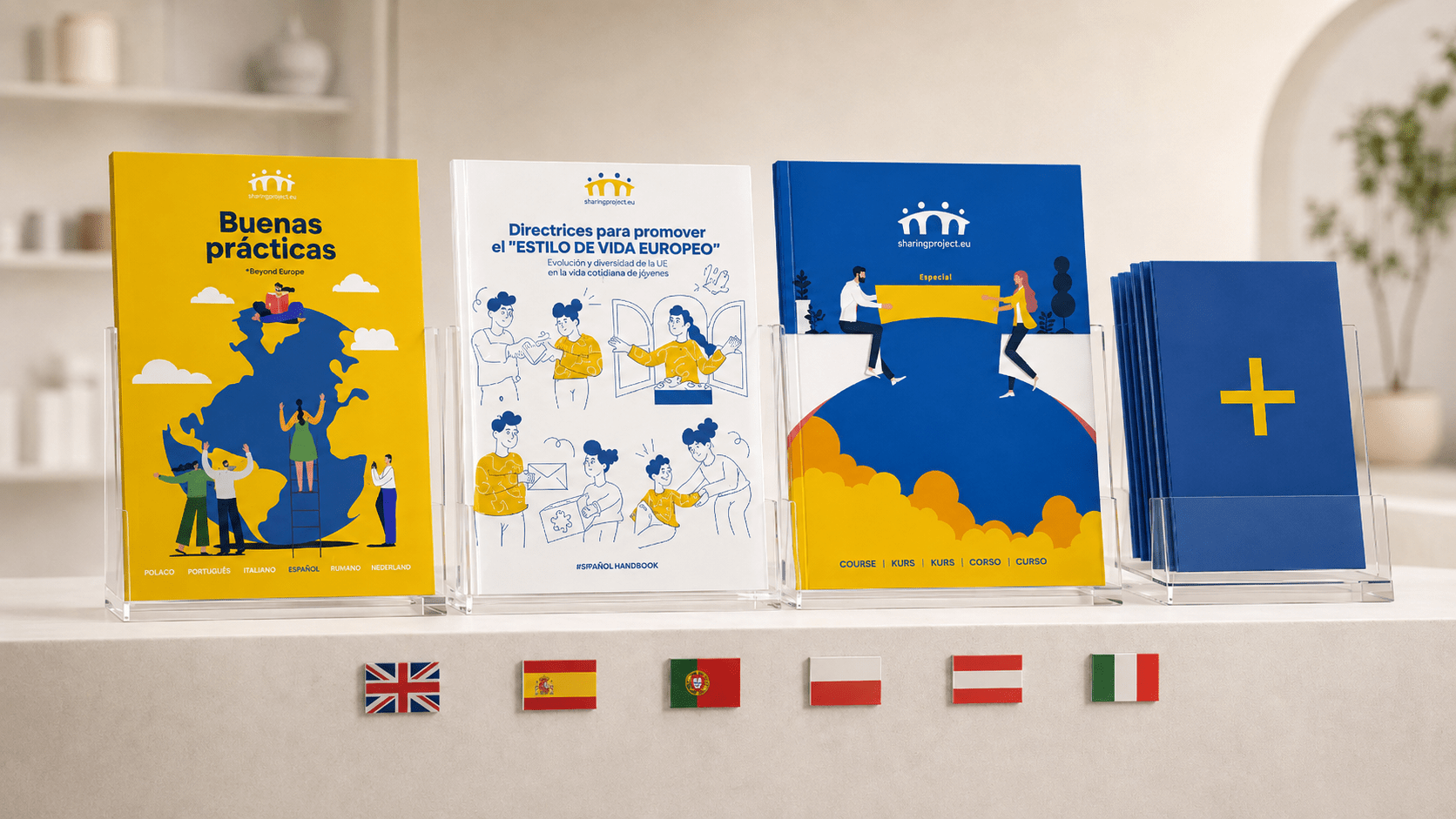
A new collection of publications, training materials and assessment resources is now available for adult education professionals, social care and psychosocial support teams, educational providers, social organisations and public authorities.
PUENTE Project has published four complementary resources designed to strengthen professional and organisational practice in non-formal education, social and labour inclusion and psychosocial support. The materials bring together practical knowledge developed through cooperation between organisations working across education, healthcare, social support, accessibility, employment and European collaboration.
All resources can now be explored and downloaded from the PUENTE Project materials page.
Why these resources are needed
Across the European Union, support for people displaced from Ukraine continues to require sustained educational, social and community responses. On 31 May 2026, 4.38 million people who had fled Ukraine held temporary protection status in the EU. These figures underline the importance of moving beyond immediate reception measures and continuing to develop long-term approaches to learning, participation, employment, autonomy and belonging.
Education cannot remove every structural barrier by itself. However, non-formal learning can make an important contribution when it is connected with specialised services, access to rights, psychosocial support, employment opportunities and safe and accessible learning environments. Professionals and organisations therefore need resources that help them understand different experiences and needs, reflect on their own practice and design responses that recognise the dignity, knowledge and capabilities of every person.
Four complementary materials
Good Practices Handbook
The Good Practices Handbook brings together educational, social and community experiences from different European contexts.
The practices present their objectives, implementation conditions, required resources, lessons learned and possible challenges. They cover approaches connected with non-formal education, individualised support, psychosocial care, community participation, labour inclusion and creative activities.
Rather than presenting universal solutions, the handbook provides examples that professionals and organisations can examine critically and adapt responsibly to their own settings.
Integration of Ukrainian Refugees
Integration of Ukrainian Refugees offers practical guidance on the different dimensions that can influence inclusion.
The publication addresses rights and European values, cultural diversity, education, language learning, employment, housing, healthcare, access to services, safety and civic and community participation.
It is intended for educational institutions, social organisations, professional teams, public authorities and programme leaders. It may also support people seeking accessible information about life and participation in host communities.
Its approach recognises that inclusion is not limited to employment. It also involves autonomy, access to information, opportunities to learn, participation in community life and the ability to make informed decisions.
PUENTE complete course
The PUENTE complete course is a non-formal education pathway with an indicative duration of 20 hours and nine chapters.
The course addresses sociocultural and historical context, legal frameworks and inclusion policies, health, psychological and social dimensions, inclusion and empathy, intercultural communication, inclusive teaching practices, trauma-sensitive approaches and practical case analysis.
It is supported by teaching and assessment components that facilitate both independent learning and training activities organised by educational and social organisations.
The course is particularly relevant to adult educators, trainers, social care professionals and psychosocial support teams seeking to strengthen their knowledge while reflecting on diversity, accessibility, participation and educational design.
Refugee inclusion assessment tool
The Refugee inclusion assessment tool helps organisations and teams review their inclusion practices.
It supports reflection on educational and community participation, access to learning, autonomy, intercultural communication, psychosocial support, accessibility and sense of belonging.
The tool can help teams recognise existing strengths and identify possible priorities for improvement. It is not a clinical or diagnostic instrument, an official audit or a certification process.
Explore the full collection
The complete collection is now available on the PUENTE Project website:
Explore and download all PUENTE Project materials
About PUENTE Project
PUENTE Project—Protecting Ukrainians Encouraging Non-formal Training and Education—is an Erasmus+ cooperation partnership in adult education. It works to strengthen the capabilities of educators, social care professionals and other stakeholders supporting the social and labour inclusion of Ukrainian refugees through non-formal education and psychosocially informed practice. PUENTE Project is implemented by organisations in six European countries.
The PUENTE project is co-funded by the European Union. The views and opinions expressed are solely those of its author(s) and do not necessarily reflect those of the European Union or the Spanish Service for the Internationalisation of Education (SEPIE). Neither the European Union nor the SEPIE National Agency can be held responsible for them.
Leave a Reply