

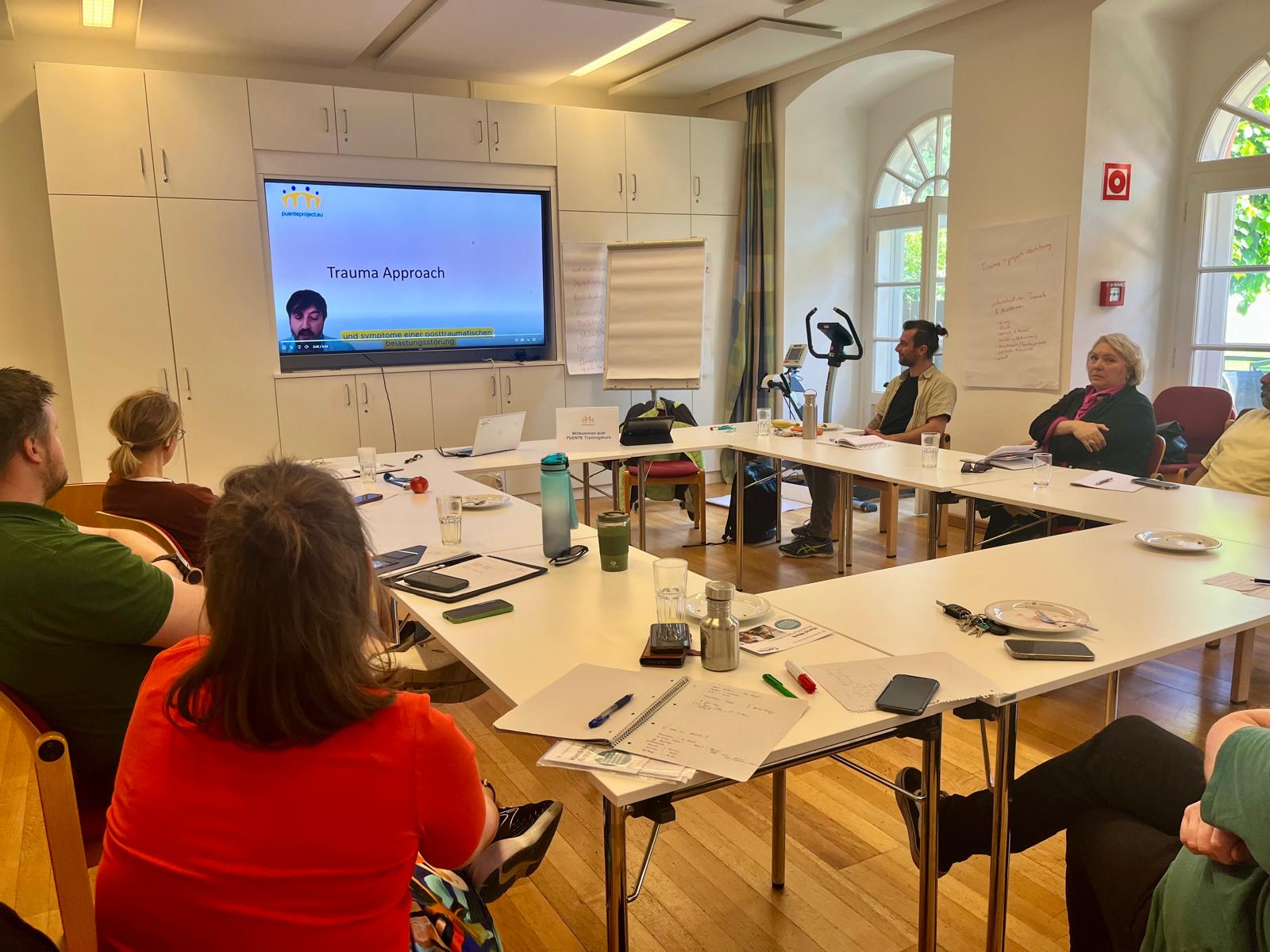
The PUENTE Project has taken an important step forward with the launch of its first local pilot sessions for the project’s training course. These sessions have already started in several project locations, including Ciempozuelos and Valladolid in Spain, Poland, Italy and Austria, bringing the course closer to the professionals who support Ukrainian refugees in their daily work.
Over two days, each centre is gathering approximately 10 professionals, including adult educators, social carers, social workers, therapists, health professionals and other specialists. The objective is to introduce the training course, explore the materials developed by the project partners and collect practical feedback from the people who will use these tools in real educational and social care settings.
This pilot phase marks a key moment for PUENTE Project. After the design of the course and the development of training materials, the project is now moving into implementation. The local sessions are designed to test the course in different national and professional contexts, ensuring that the content responds to the needs of adult educators and social carers working with Ukrainian refugees and other groups requiring support.
In Valladolid, two sessions have already been held with 10 participants. In Ciempozuelos, professionals have also joined the pilot process, contributing their experience and local knowledge to the validation of the course. In Poland, the first meetings took place on 13–14 May at Bonifraterska Fundacja Dobroczynna in Konary, with the participation of 10 professionals, including social workers, therapists and other specialists who work every day with groups requiring support, including refugees from Ukraine. During the meetings, participants were introduced to the full training module and the materials produced through the international cooperation of the PUENTE Project.
In Italy, the pilot process includes four meetings with 10 health professionals representing different professional profiles. Their participation will help assess the relevance of the course from a health and care perspective, contributing to a multidisciplinary approach to inclusion. Austria is also part of this first phase of implementation, reinforcing the transnational dimension of the project and the importance of testing the course across different European contexts.
The broader pilot phase aims to involve 60 adult educators and social carers across five countries. Their feedback will be essential to improve the course, validate the methodology and ensure that the final materials are practical, accessible and useful for professionals supporting Ukrainian refugees.
The PUENTE training course focuses on non-formal education as a tool for inclusion, recovery and empowerment. Its contents address key topics such as the sociocultural and historical context, legal aspects and inclusion policies, health and psychosocial dimensions, empathy and inclusion awareness, collaborative work and partnerships, intercultural communication, inclusive pedagogical practices, trauma-informed approaches, resources and practical case studies.
Through these sessions, PUENTE Project is strengthening the capacity of professionals to provide educational, emotional and social support to Ukrainian refugees. The course also contributes to the creation of more inclusive educational and social care centres, better prepared to respond to diverse needs and to promote autonomy, dignity and equal opportunities.
By testing the course locally, PUENTE Project continues to build bridges between education and action, between professionals and communities, and between people seeking a new start and the support systems that can help make it possible.
This pilot phase is not only a technical step in the development of the project. It is also a collective learning process that brings together professionals from different countries, disciplines and local realities around a shared goal: building bridges towards inclusion through non-formal education.
Leave a Reply